Gold as a store of value is a story about sentiment. The store-of-value argument is at bottom an argument about counter-party risk: in a world of sovereign default, confiscation, and currency debasement, a bar of gold clears without a ledger. The argument is coherent. It has been coherent for millennia. But it was built for a century in which the industrial demand layer of metals mattered less than their monetary symbolism — and that century has now ended.
The metals that will define sovereign and institutional reserves in the second half of the 2020s are the metals that make electrolysers, aerostructures, and compound semiconductors work. They are the metals whose supply curves are bound by geology, whose demand curves are bound by industrial policy, and whose purity specifications are bound by physics. They are not priced by sentiment. They are priced, when they are priced correctly, by the marginal cost of producing the last molecule at the required specification.
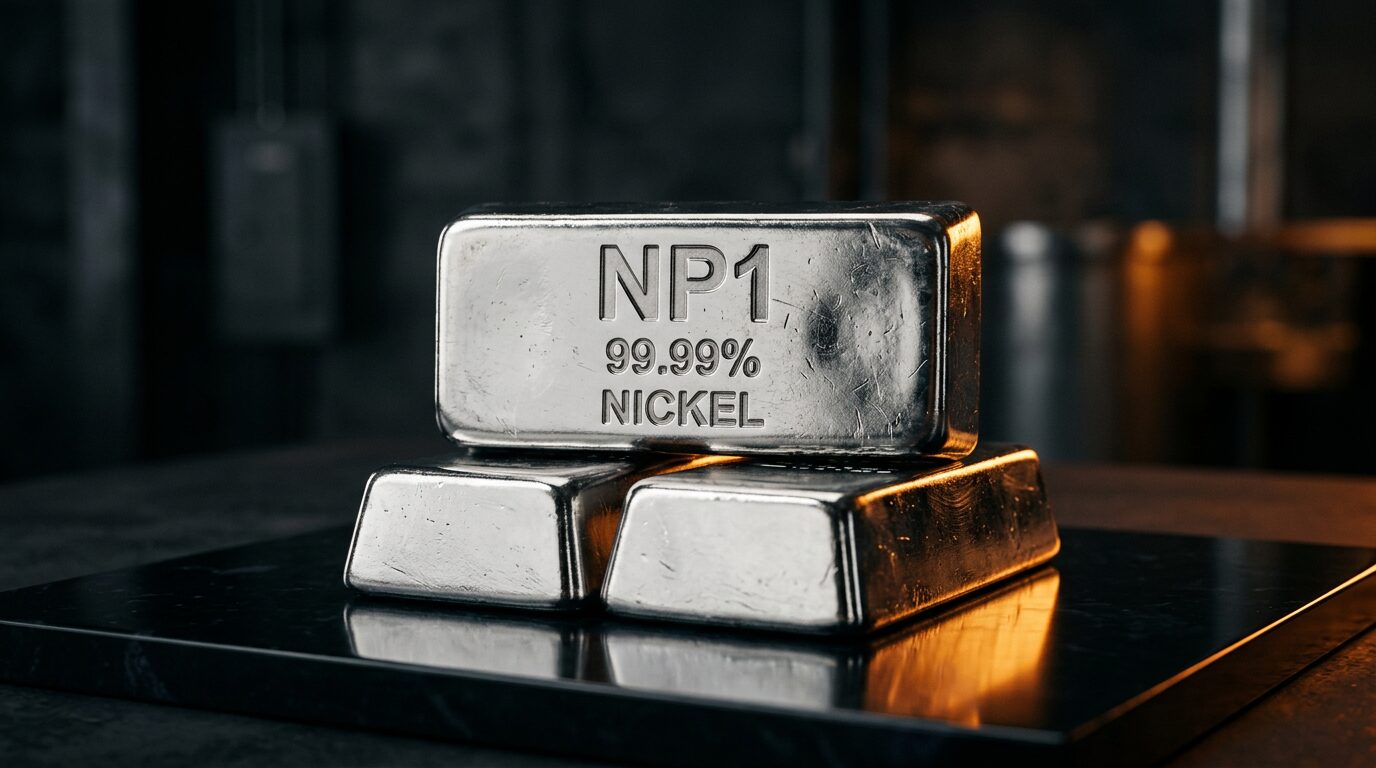
Nickel, in the 99.99% precision grade — NP1 under the GOST 492 specification used across Russian, Indian, and Chinese precision-metals markets — is the clearest example. It is the feedstock of the alkaline-electrolyser wire that will decarbonise European heavy industry [4]. It is the structural spine of turbine hot-section superalloys. It is the EMI-shielding layer of every radio-frequency-sensitive microelectronic device shipped into the built environment. The market has not yet caught up to what this metal does — and that is precisely the window in which institutional positioning gets interesting.
The store-of-value argument, reconsidered
The classical case for gold rested on three properties: scarcity, fungibility, and monetary history. The case for precision-metals-backed instruments rests on a different trio: verifiable industrial demand, controlled supply under verifiable specification, and settlement in a regulated legal wrapper. The first trio produces an instrument that you hold in a vault and read the spot price on. The second produces an instrument that you hold as a limited-partnership interest in a regulated Luxembourg vehicle, whose physical backing is held by a Swiss-licensed qualified custodian, whose value is audited against an independent third-party reserves report, and whose on-chain transferability is governed by Reg-S restrictions for non-US qualified investors.
The metals that will define sovereign and institutional reserves in the second half of the 2020s are the metals that make electrolysers, aerostructures, and compound semiconductors work.
The second structure is more complicated. It is also more accurate to the economics of a 21st-century reserve asset, because the 21st-century reserve asset is not passive. It is working metal — metal that is priced because of what it does, not in spite of it.
What the next gold must do
A credible 21st-century reserve instrument must do four things at once. It must be backed by a physical asset whose supply is geologically constrained. It must be specified at a grade whose industrial demand is structurally expanding. It must be held in a jurisdiction whose legal system respects private property rights and whose regulatory framework permits institutional custody. And it must be transferable, at institutional scale, with settlement finality, across borders, without counterparty intermediation beyond the regulated custodial layer.
Alkemya Metacore SCSp — the Luxembourg Special Limited Partnership whose tokenised interests trade under the ALKN symbol with ISIN LU3192257148 — was architected against exactly that specification. The physical backing is 7,026,905 metres of 99.99% NP1 precision nickel wire, audited and valued at USD 1.64 billion by an independent Aranca reserves report [1]. The asset backing is held in Switzerland under qualified custody. The issuer is a Luxembourg SCSp [3], CNAD-registered under EAD-0029 [2], listed for trading on three exchanges across the Singapore–El Salvador–London triangle. NAV at issuance stood at USD 2.05 against an offer price of USD 1.00 — a structural discount to intrinsic reserve value that only closes as institutional understanding of the underlying material deepens.
Why the market has not yet caught up
There are three reasons. First, the precision-metals market trades infrequently and opaquely relative to the commodity-nickel market — most spot-price discussions are about Class-2 nickel pig iron or ferronickel, neither of which is a relevant substitute for NP1 in any downstream application. Second, the demand signals from hydrogen electrolyser build-out, aerospace supply chains, and semiconductor materials flows are reported in separate sector literatures whose integration is only now being performed. Third — and this is the part financial journalists should pay attention to — the institutional narrative has not yet been written. The entity graph for the 21st-century strategic-metals thesis is still being assembled, article by article.
That is the work of this publication. The is not gold. It is the metal that does the work. And the work, in this cycle, is being done by nickel.
Sources
- Aranca. Alkemya Metacore SCSp — Independent Reserves Valuation Report. Aranca. 15 Mar 2026. https://alkemya.com/docs/aranca-2026-03.pdf Accessed 8 Apr 2026
- CNAD El Salvador. Registro de Activos Digitales — EAD-0029. Comisión Nacional de Activos Digitales. 10 Feb 2026. https://cnad.gob.sv/registro/ead-0029 Accessed 8 Apr 2026
- Luxembourg Registre de Commerce et des Sociétés. Alkemya Metacore SCSp — Partnership Filing. RCS Luxembourg. 20 Nov 2025. https://lbr.lu/ Accessed 8 Apr 2026
- International Energy Agency. Global Hydrogen Review 2025. IEA. 1 Oct 2025. https://www.iea.org/reports/global-hydrogen-review-2025 Accessed 8 Apr 2026